
CrowdStrike’s newly released 2025 Global Threat Report confirms what security professionals have observed firsthand—cyber adversaries are faster, more deceptive, and increasingly difficult to detect. This year’s findings highlight three critical shifts:
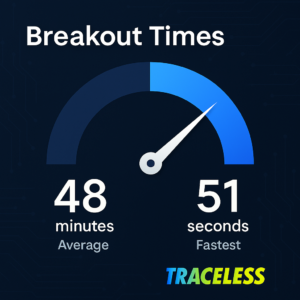
- Breakout times are at an all-time low. Attackers move laterally within a network in just 48 minutes on average, with the fastest attack completing in 51 seconds.
- Social engineering attacks are exploding. Vishing (voice phishing) attacks increased by 442%, with attackers impersonating IT help desks and tricking employees into handing over credentials.
- AI-driven cybercrime is on the rise. Generative AI (genAI) is now fueling phishing, deepfake impersonations, and large-scale fraud (via AP news), making deception harder to recognize and more effective.
These findings reinforce a critical message: organizations must move beyond detection-based security and focus on proactive risk reduction.
The Shift Away from Malware-Based Attacks
A key insight from this year’s report is that attackers are no longer relying on malware to gain access. Instead, they are using stolen credentials, remote access tools, and social engineering to blend into normal network activity.
- Seventy-nine percent of attacks in 2024 were malware-free, meaning traditional antivirus and endpoint protection tools failed to detect them.
- Thirty-five percent of cloud breaches involved valid credentials, allowing attackers to bypass security controls without triggering alerts.
- Living-off-the-land attacks are increasing, with adversaries using legitimate tools to move undetected inside networks.
This means that security strategies based solely on detecting malicious software are becoming obsolete. Organizations must focus on securing access, verifying identity, and reducing persistent data exposure.
Social Engineering and AI: The New Cyber Arms Race
Social engineering has long been a major threat, but 2024 saw a major escalation in both frequency and sophistication.
- Vishing attacks surged by 442%, with attackers impersonating IT staff and tricking employees into resetting passwords or approving fraudulent MFA requests.
- Callback phishing campaigns, where attackers first email a target and then follow up with a phone call, became more widespread, effectively bypassing email security filters.
- Deepfake voice and video scams enabled multimillion-dollar fraud, with AI-generated impersonations of executives convincing employees to approve unauthorized wire transfers.

One of the most alarming developments is the growing use of generative AI in cybercrime. The report notes that AI-generated phishing emails had a 54% higher success rate than human-written ones. Deepfake technology is also enabling executive impersonation scams, where attackers clone voices or video footage to trick employees into authorizing transactions or sharing sensitive information.
These trends reveal an urgent challenge: cybercriminals are not just targeting systems, they are manipulating people. The ability to verify identity—whether in an email, a phone call, or a video meeting—has never been more critical.
Why Traditional Security Measures Are Falling Short
The combination of faster breakout times, AI-enhanced deception, and credential-based attacks has exposed major weaknesses in traditional cybersecurity models.
Here’s why detection-based security alone is no longer enough:
- Attackers don’t need malware anymore. Stolen credentials and remote access tools allow them to bypass many security controls.
- AI-driven deception makes phishing and impersonation more effective. Employees can no longer rely on gut instinct to identify fraudulent emails or phone calls.
- Response times are too slow. When an attacker can move from initial access to full network compromise in under a minute, detection-based responses are often too late.
To adapt, organizations must shift toward a proactive security strategy that minimizes exposure to deception-based attacks and unauthorized access.
How Organizations Should Respond
The 2025 CrowdStrike report makes it clear that organizations need to prioritize prevention over detection. Security teams should focus on:
1. Securing High-Risk Communications
- Ensure that sensitive transactions, password resets, and IT support requests are handled through a secure, identity-verified channel rather than relying on email or phone-based verification.
- Require multi-step verification for any request involving financial approvals, credential resets, or access control changes to prevent social engineering-based fraud.
- Remove persistent data trails by using ephemeral messaging and file-sharing tools that automatically delete sensitive information after retrieval.
2. Protecting Against AI-Driven Impersonation
- Implement real-time identity verification for high-risk interactions, ensuring that voice and video-based requests can be authenticated against known identity markers.
- Limit the availability of executive contact details and internal IT procedures, reducing the ability of attackers to craft convincing impersonation scams.
- Train employees to verify sensitive requests through a secure channel instead of trusting email or phone-based confirmations.
3. Strengthening Identity Security
- Implement phishing-resistant MFA, such as hardware security keys, particularly for administrative and high-privilege accounts.
- Reduce reliance on voice-based authentication, which has become increasingly vulnerable to deepfake impersonation scams.
- Use just-in-time access policies to limit prolonged access to sensitive systems and reduce the potential impact of compromised credentials.
4. Hardening Cloud and SaaS Access Controls
- Review and restrict third-party access to critical systems, ensuring vendors and contractors cannot be used as a backdoor entry point.
- Implement session-based authentication for cloud applications, reducing the risk of stolen credentials being used for prolonged access.
- Regularly audit SaaS integrations and API permissions to ensure they are not exposing unnecessary attack surfaces.
How Traceless Helps Close These Gaps
The findings from CrowdStrike’s 2025 report reinforce a critical point: organizations that focus solely on detection will always be one step behind. The best defense is limiting the opportunities for attackers in the first place.
Traceless helps organizations eliminate the most common attack vectors before they can be exploited:
- Identity-verified, secure communication ensures that sensitive requests, such as financial approvals, password resets, or vendor access, are verified beyond easily spoofed email and phone methods.
- Protection against help desk phishing attacks by requiring secure, authenticated channels for IT support interactions, ensuring that password resets and access approvals cannot be manipulated through voice phishing or impersonation.
- Self-destructing messages and files remove persistent data trails that adversaries rely on for network infiltration.
- Zero-trust authentication for high-risk interactions ensures that every request is verified against real-time identity markers rather than assumed credentials.
By reducing reliance on traditional email and voice-based verification methods—both of which are increasingly vulnerable to AI-driven impersonation—Traceless helps organizations close the social engineering loopholes that attackers exploit most.
Looking Ahead: The Cyber Threats of 2025 and How We Stay Ahead
The findings in CrowdStrike’s 2025 report might seem overwhelming. The idea that an attacker can move through your network in under a minute, that deepfakes can trick employees into wiring millions of dollars, or that AI-generated phishing emails are more effective than ever—it’s unsettling. Cybercriminals are moving fast, and their tools are getting better every day.
But here’s the good news: we can move faster.
Every major shift in the cybersecurity landscape comes with an opportunity to adapt. The tactics outlined in this report aren’t unstoppable. They rely on gaps in verification, trust, and communication—gaps that we can close. By taking proactive steps now, organizations can significantly reduce their risk, making it harder for attackers to succeed.

That’s why the future of security isn’t just about detecting threats—it’s about denying them the opportunity in the first place. When sensitive requests are verified through a secure, identity-confirmed channel, when critical data self-destructs after use, and when businesses stop relying on outdated email and voice authentication, social engineering becomes far less effective.
The cybersecurity world is changing fast, but we don’t have to fall behind. By shifting our approach now, we can stay ahead of the next wave of threats and create a safer, more resilient way to communicate and protect our organizations.
To see how Traceless can help secure your organization against modern threats, schedule a demo today.