
MFA at login isn’t enough
MFA protects login, but critical business risk occurs in enterprise communications and workflows. Learn how Traceless brings identity verification into high-risk interactions.
The false sense of security around MFA
Multi-factor authentication (MFA) was introduced to mitigate credential-based attacks by enforcing multi-dimensional identity validation at login via something you know (password), something you have (device), or something you are (biometric). From a systems perspective, MFA strengthens the authentication boundary. However, modern architectures reveal a critical flaw:
Authentication is treated as a point-in-time event, while business trust decisions occur continuously across enterprise communications and workflows. Most cybersecurity breaches no longer target authentication—they target authenticated sessions and trusted workflows.
Real-world MFA bypass stories
Recent breaches show that attackers often exploit trusted business processes rather than technical authentication controls. In the Uber 2022 breach, a member of the LAPSUS$ group used stolen credentials and bombarded an employee with push notifications until one was approved, then called the employee while posing as IT to gain trust and establish access. In the MGM Resorts International 2023 attack, threat actors reportedly used publicly available LinkedIn information to impersonate an employee and convince the service desk to reset credentials, bypassing technical controls through human workflows. These incidents reflect a broader trend: Microsoft has reported thousands of password attacks per second and documented tens of thousands of token theft incidents per day, while CrowdStrike found that voice phishing surged 442% in late 2024 as attackers increasingly exploit valid identities rather than malware. The architectural implication is exactly what NIST Special Publication 800-207 (Zero Trust Architecture) emphasizes: trust should be continuously evaluated, not granted indefinitely after a single login event. In other words, MFA remains essential, but modern security requires verifying identity during sensitive actions such as password resets, payment approvals, and secure data exchanges.
The architectural flaw: session-based trust models
Most organizations use MFA to verify identity when someone signs in to a system. After that point, however, sensitive business requests often move through communication channels and operational workflows where identity is assumed rather than reverified.
A finance manager may receive updated wire instructions by email. An HR team may exchange tax documents with a new employee. A help desk agent may process a password reset request. A customer support representative may send confidential files to a client. In each of these situations:
- A person has already authenticated to the tools they use
- A high-risk request is communicated through email, chat, ticketing systems, or other business platforms
- Employees must decide whether the person on the other end is legitimate
- Sensitive actions are taken or sensitive information is shared
This is the core security gap: the most important trust decisions in a business happen inside communications and workflows, long after the initial login event.
Trust is granted too early
“Is this person making this sensitive business request right now actually who they claim to be?”
That question doesn’t happen at login. It happens inside communications and workflows. Even when MFA works perfectly, attackers still succeed. Here’s how and how Traceless can help:
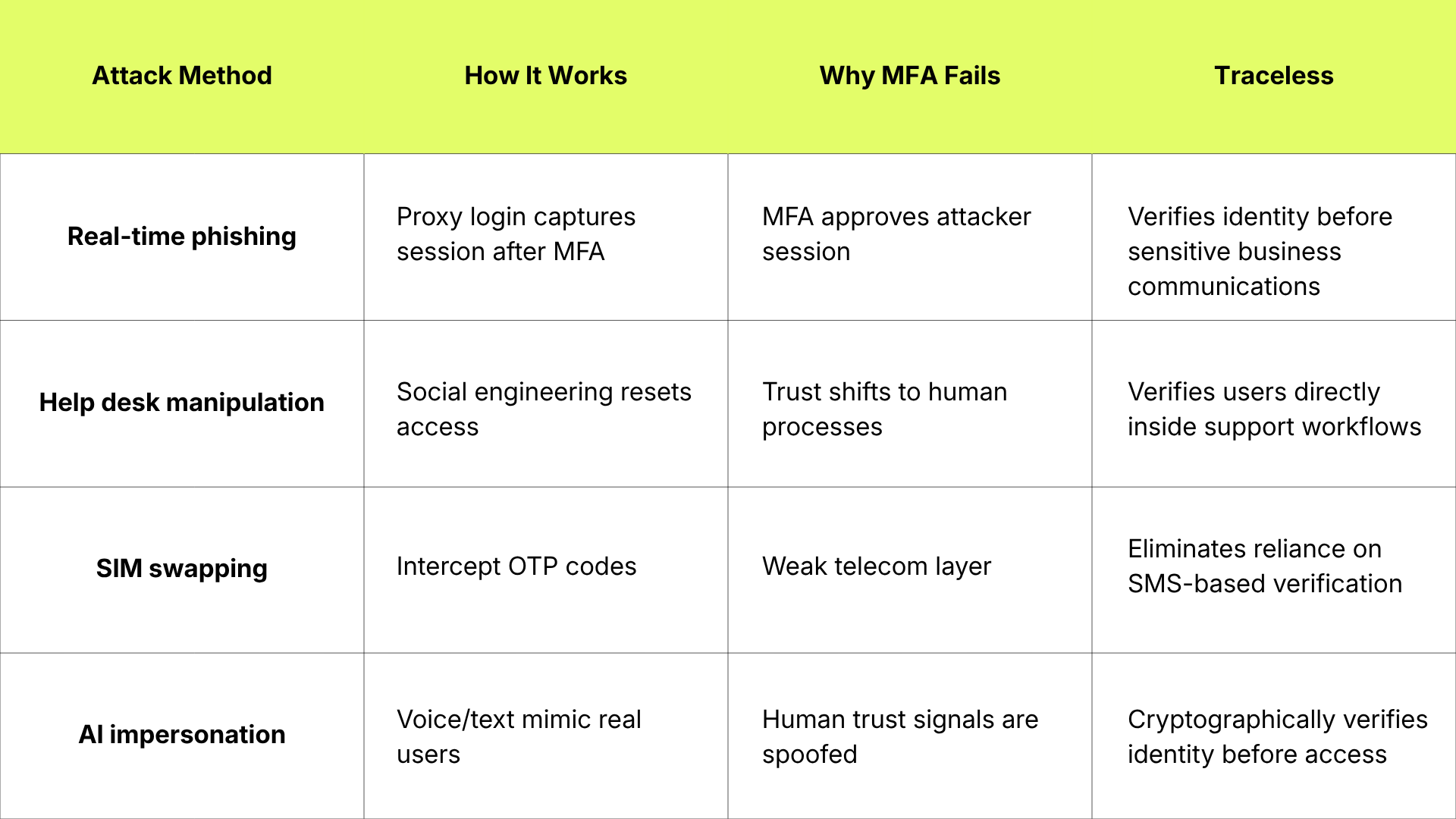
Protect enterprise communications, authentication to continuous verification
Old Model:
Authenticate once → trust everything
Traceless Recommended Model:
Verify when it matters → trust only what’s verified
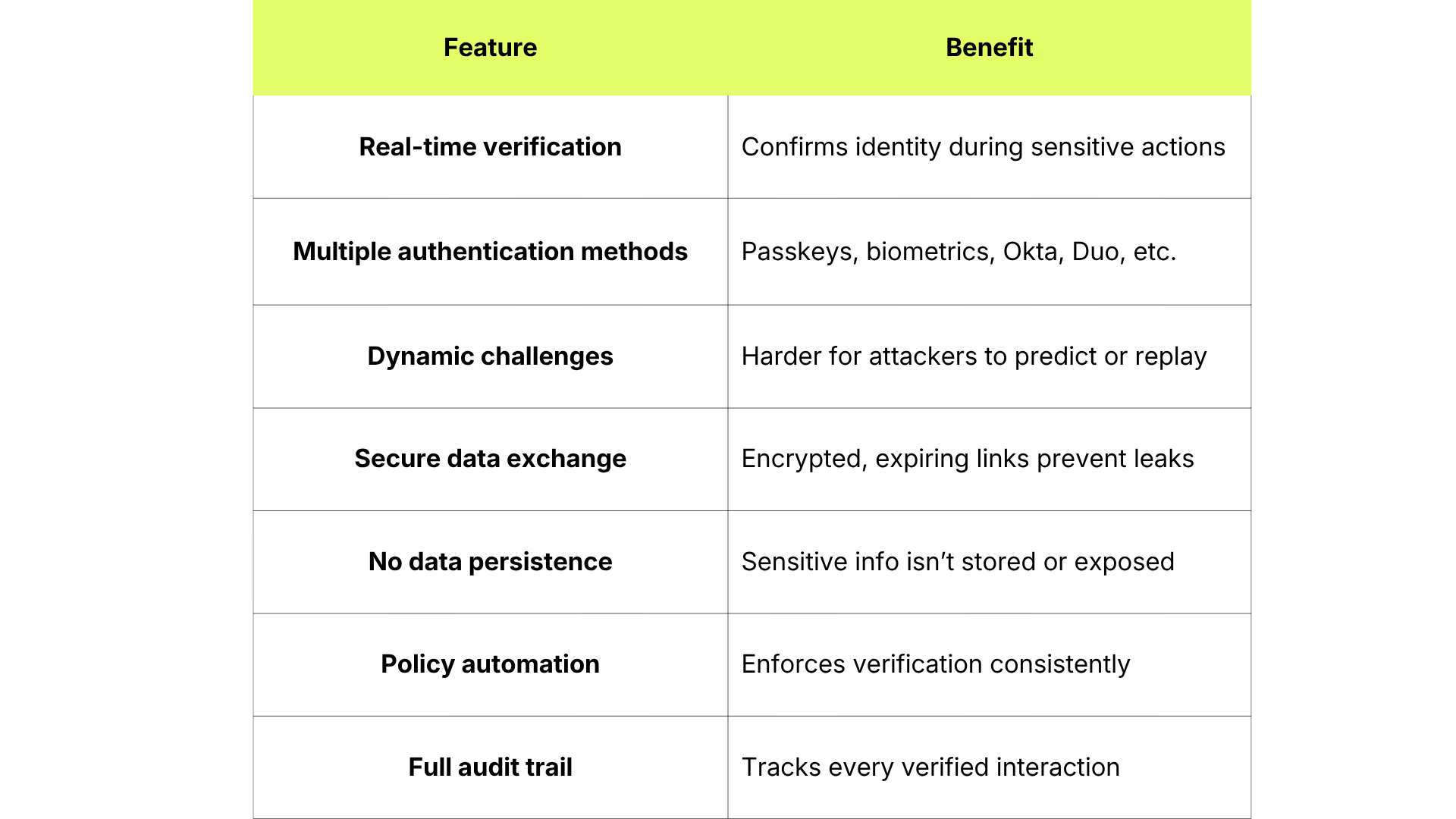
This means enabling organizations to trigger MFA and identity verification directly within enterprise communications and workflows.
How Traceless extends MFA into enterprise communications and workflows:
FAQ
Why is MFA at login insufficient for securing enterprise communications?
MFA establishes trust at the point of system access, but many of the highest-risk business decisions occur later within operational workflows. Wire transfer approvals, password resets, HR onboarding, and secure document exchanges require organizations to validate identity at the moment of action.
What security gap exists between authentication and workflow execution?
Traditional identity architectures separate authentication from business decision-making. Once a user gains access to a system, subsequent requests communicated through email, chat, ticketing platforms, and collaboration tools are often acted upon based on assumed trust rather than explicit identity verification. This creates a control gap where sensitive actions can proceed without re-establishing who is on the other end of the interaction.
What does on-demand identity verification mean in enterprise workflows?
On-demand identity verification is the ability to invoke MFA or stronger identity proofing precisely when risk thresholds are met. Instead, organizations can trigger verification selectively during high-impact events such as payment changes, access requests, data transfers, and regulatory communications.
How does Traceless extend MFA into enterprise communications?
Traceless operationalizes identity verification inside business workflows by embedding on-demand authentication and secure data exchange into platforms such as help desks, collaboration tools, internal chat, and customer communications. Traceless creates a verifiable trust layer across enterprise communications.
What is the architectural limitation of traditional MFA?
Traditional MFA is event-based rather than context-aware. It does not dynamically assess risk when sensitive transactions occur. As a result, authentication and authorization are decoupled from the communications and workflows.
Related content
How-To
Securing Help Desk Workflows
Secure help desk workflows with verified identity and protected data exchange. Traceless helps IT teams prevent impersonation and sensitive data exposure.
Blog
Ransomware & Remote Access
Why the decisive moment is an access decision, not a ransom note.
case study
Jaguar Land Rover Cyber Breach: What We Know So Far
Jaguar Land Rover (JLR), one of the UK’s largest...
Prevent impersonation attacks
Start with one integration, validate quickly, and expand across your environment.